
You’ve decided to open an online ethnic wear boutique. Great idea — Indian ethnic fashion is a market that never slows down. But there’s a big difference between “putting products online” and “launching a business that gets found, trusted, and ordered from.”
Most people do the first. Very few do the second.
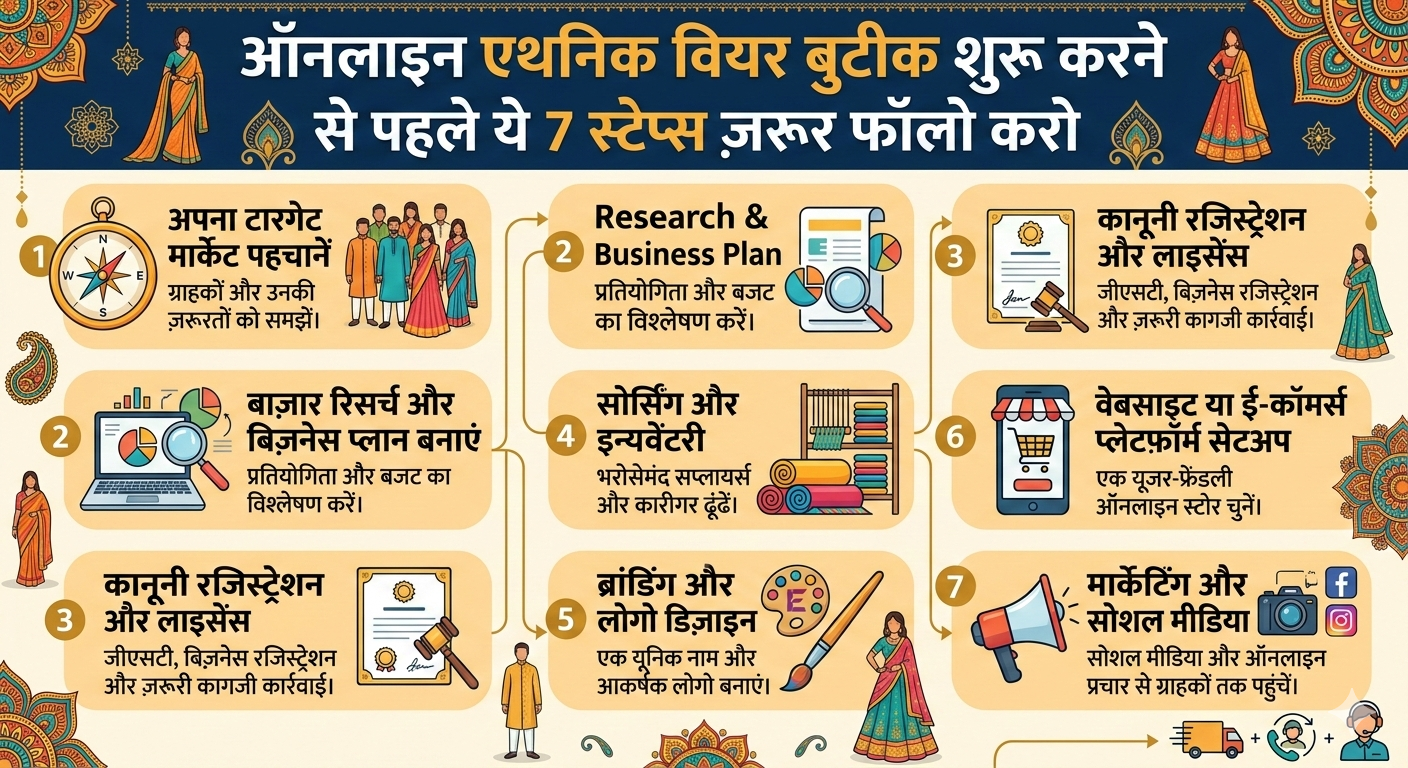
This guide covers the 7 steps that separate boutiques that get traction from day one from those that sit quietly on the internet with zero visitors and zero orders for months. If you’re planning to launch — or you’ve already launched but aren’t getting results — this is for you.
Why Most Ethnic Wear Boutiques Fail Before They Even Start
Here’s a pattern that plays out constantly: someone sources beautiful suits and sarees, sets up a free website or Instagram page, posts 20 photos with prices, and then… nothing. They wait. They maybe tell a few friends. A trickle of visitors. Zero conversions.
The problem isn’t the product. Indian buyers love discovering new boutiques. The problem is that the business was built without foundations — no discoverability, no trust signals, no name that sticks, no SEO. You can’t build a shop and just hope people walk in. Online, you have to build roads that lead there.
These 7 steps build those roads.
Step 1: Lock In a Name Before You Do Anything Else
Your boutique’s name is not a small decision. It affects your SEO, your social media discoverability, your word-of-mouth, and whether customers can find you again after their first visit. And yet most new boutique owners treat it as an afterthought — “main baad mein dekh loongi.”
A good boutique name should:
- Be easy to pronounce and remember in Hindi and English
- Not already be used by 50 other Instagram boutiques
- Give a feel for what you sell (ethnic, traditional, premium, affordable)
- Be available as an Instagram username and ideally as a domain
Before you print a single pamphlet or set up an Instagram handle, run a similar business name search to see how many boutiques are already operating under that name or close variations. You don’t want to build a brand for 6 months and then find out there’s already a well-known “Meera Collection” in your city or even nationally. Start unique.
Step 2: Set Up Your Website the Right Way (Even If It’s Simple)
You don’t need a fancy website. But you need one that search engines can crawl and customers can trust. For ethnic wear, a clean product catalog with good photos, a WhatsApp contact button, and an Instagram link is enough to start.
What most people skip: making sure Google actually knows your site exists. Search engines don’t automatically find and index new websites. You need to tell them. The very first SEO task after your site is live should be generating a sitemap — a file that maps all your pages for search engines to crawl. You can create one in minutes using a free sitemap generator tool, then submit it to Google Search Console.
This one step means Google starts discovering your pages within days instead of months. For a new boutique competing for terms like “ethnic wear online” or “salwar suits [your city],” every day of delay costs you potential organic traffic.
Step 3: Get Your Product Photography Right
In ethnic wear, photography is everything. A beautiful lehenga with a blurry photo gets scrolled past. A basic cotton kurti with clean, bright photography gets orders.
You don’t need a professional photographer for every piece. What you need:
- Natural light (window light in the morning works great)
- Clean, neutral background — white wall, plain bedsheet
- Same framing and style across all products (consistency builds trust)
- At least 2-3 photos per product — full front view, close-up of fabric texture, and ideally styled on a model or hanger
Your photography style becomes your brand identity. Buyers who land on your Instagram page or website should be able to tell immediately what kind of boutique you are — budget casual, festive premium, bridal specialist — just from how the photos look.
Step 4: Build Your Collection Around a Season and a Segment
Don’t launch with 100 random products. Launch with a tight, curated collection of 15-25 pieces that tell a story. “New summer cottons for working women” or “Complete wedding guest outfits under ₹2500” — pick a theme.
This does two things: it makes your marketing easier (you have one clear message), and it makes buyers feel like you understand their specific need rather than just dumping a catalog on them.
After your first collection lands, watch what sells. Double down on those categories. Add new products based on customer requests and what’s moving, not just what you personally like.
Step 5: Research Your Competitors Without Getting Spotted
Before you finalize your pricing, categories, and brand positioning, you need to know what other ethnic wear boutiques are doing. What are they charging? Which products are getting the most engagement? What are customers complaining about in their comments?
This research phase often means signing up for competitor newsletters, downloading their catalogs, and joining their WhatsApp broadcast lists — all of which floods your inbox with promotional emails for months. Many boutique founders keep a separate email account just for this purpose. A temporary email for research signups means your main business email stays clean and you can focus inbox space on actual suppliers, logistics partners, and customer messages.
Good competitor research tells you:
- Price ranges that the market accepts in your niche
- Which designs are oversaturated (avoid these)
- Gaps — segments nobody is serving well (target these)
- What messaging resonates with your shared target audience
Step 6: Create Content Before You Launch, Not After
The biggest launch mistake: waiting until everything is “ready” to create content. By the time you launch, you should already have an audience waiting.
Start your Instagram page 4-6 weeks before your launch date. Post behind-the-scenes content — sourcing trips, packing your first orders, fabric selection, the story of why you started. People connect with founder stories. They want to buy from a real person, not a faceless catalog.
Build your WhatsApp broadcast list before launch. Every person who sees your “coming soon” posts and messages you is a potential first customer. Capture every one of them into a WhatsApp list.
Plan a launch day post with a limited offer — “First 10 orders get free shipping” or “Launch day only: 15% off everything.” Scarcity and firsts create urgency. Your pre-launch content builds the audience; your launch offer converts them.
Step 7: Set Up Tracking From Day One
Once you’re live, you need to know what’s working. Most boutique owners have no idea where their customers come from — Instagram? Google? WhatsApp forwards? — because they never set up any tracking.
The minimum setup:
- Google Analytics on your website (even a simple one) so you can see traffic sources
- Google Search Console to see which search terms are bringing visitors (and submit your sitemap from Step 2)
- UTM links in your Instagram bio so you can see how much website traffic comes from there
This data tells you where to invest your time and energy. If 80% of your orders are coming from WhatsApp, double down on building that list. If Instagram Reels are driving traffic but no conversions, fix your website, not your Reels strategy.
The Long Game: Building Trust Takes Time
Here’s the reality of online ethnic wear: you’re not going to be flooded with orders in week one. Unless you go viral, growth is steady and compounding. The boutiques that succeed are the ones that show up consistently, improve their photography, respond to every inquiry quickly, and handle the rare bad experience gracefully.
Your first 10 customers are gold. They tell their sisters, their moms, their friends from the kitty party group. One genuine “this boutique is so good” recommendation in a WhatsApp group can bring you 5 new buyers. Make every single early customer feel like a VIP.
Ethnic wear is deeply personal — these aren’t just clothes, they’re what people wear to their most important moments. When a customer trusts you with that, and you deliver, you have a loyal buyer for years.
Build that trust. Do it systematically. And do it starting today, before your first product even goes live.